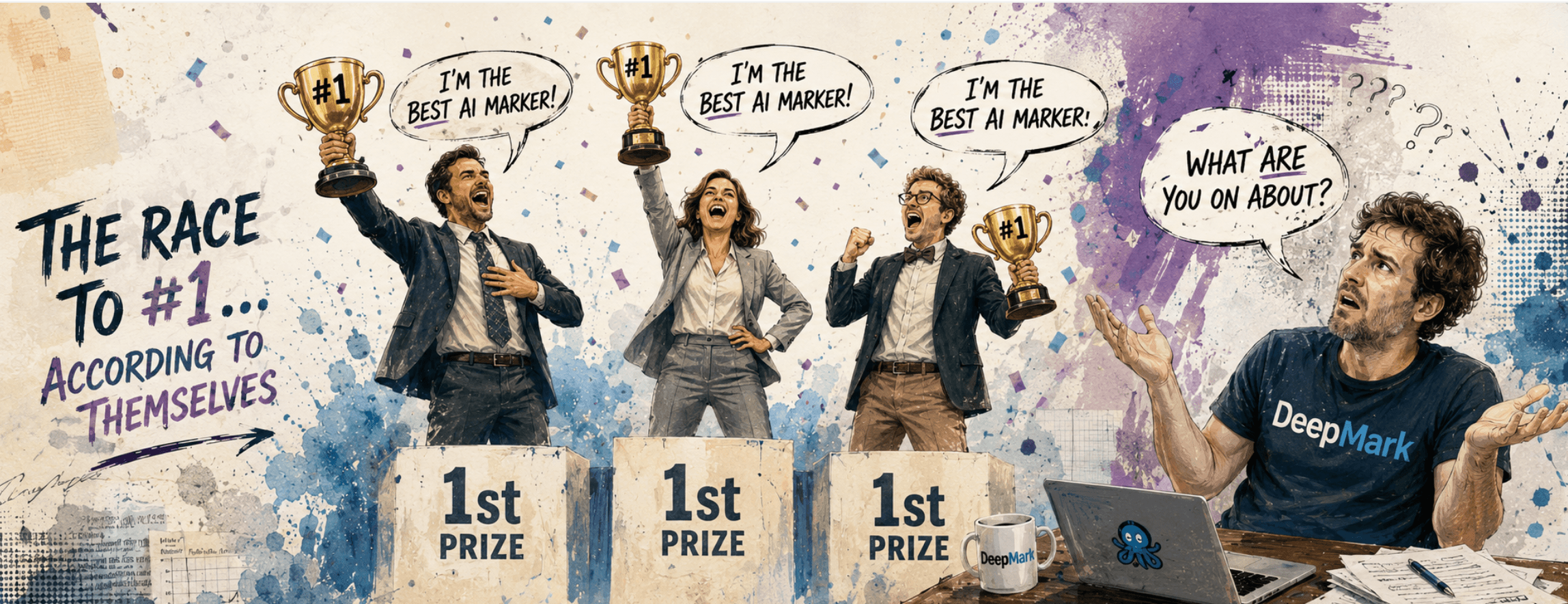
The best AI marking tools for GCSE in 2027 (it's not us)
Yes, 2027. We are aware it is not 2027 yet.
Yes, not ours, and in fact it is not anybody's. As for those writing the top five lists and conveniently placing their own product at the top, let us just say teachers like us are not that easily fooled.
Why 2027? Seven months is a geological era in AI progress. A tool that was impressive in January 2026 is now what competitors benchmark against to make themselves look good. So rather than publish another "best tools 2026" post to sit alongside the eight that already exist and proclaim themselves champion, we are calling it early and writing one that will still be roughly true in 2027.
Disclosure before anything else: we make one of these tools. DeepMark is ours. Read accordingly.
There is no best AI marking tool
That is not modesty. It is the actual finding, and it is the reason most of the comparison posts in this category are useless to you.
Search "best AI marking tools" and you will find a lot of results. GradeOrbit publishes one. Top Marks AI publishes one, in which they conclude that they are the only platform with benchmarked tools, published accuracy studies and independent validation. GradeDrive puts three numbers above the fold on their homepage: seventy five percent less time marking, five hundred teachers, and ninety eight percent accuracy against manual marking. No subject. No sample size. No methodology. Just ninety eight percent, sitting there.
We are not picking on GradeDrive specifically. We are pointing at the number because it is the clearest example of the thing this whole category does, which is to publish a figure with nothing behind it and hope you do not ask.
The format is broken because the question is wrong. "Which is best" has no answer. "Best for what, marking which subject, used by whom, cleared by which data policy" has several answers, and they are different answers.
So this post is a decision framework rather than a leaderboard. We will tell you what each tool is genuinely built for, including ours, and give you the criteria to ignore our conclusion entirely.
What Ofqual actually said, and what it does not cover
In January 2026 Ofqual published a working paper on the principles of AI use in marking. It is the closest thing to a neutral evaluation framework this sector has, and as far as we can tell nobody in the comparison post arms race is using it.
Two things about it matter, and most people only quote the first.
The first is the headline. Ofqual's position is that using AI as the sole mechanism for awarding marks does not comply with their current regulations, because it fails their requirement for human judgement in marking decisions.
The second is the scope, and this is where people overreach. That paper is about high stakes marking in regulated qualifications, and Ofqual regulates awarding organisations. It is about what happens to the script that decides a student's grade. You marking a Year 11 mock on a Sunday afternoon is not inside that perimeter, and anyone telling you Ofqual has banned a competitor's product is stretching a document that was not written about your classroom. We are not going to do that, tempting as it is.
What is genuinely useful is Ofqual's conclusion about where AI is ready now. Their finding is that AI is promising for quality assurance and marker training, but nowhere near ready to take over high stakes marking on its own. That is the regulator saying the mature use of this technology today is checking marking rather than replacing it. Keep that in mind when a tool is sold to you on the promise that you will never read a script again.
From that, the questions that actually decide this:
Who is using it, one teacher with their own pile, or a department marking to a shared standard.
What are you marking, extended writing, STEM notation, or short answer recall.
Whose scheme, a published board mark scheme, or an internal assessment with nothing written down.
What happens after the marking, marks into a spreadsheet, or feedback into a lesson.
What will your DPO sign, on retention, location, and training on uploads.
What does it cost per paper, once you do the arithmetic rather than reading the advertised price.
Your answers to those six decide which tool you want. Nobody else's answers are relevant.
The three categories, which most comparison posts blur
Question level markers. You submit one answer and get a mark and feedback back, one question at a time. Tutor2u's Examiner AI, ReMarkAble AI, AI Marker, MasteryMind, exam-mate. Several of these market to teachers as well as students, and Examiner AI in particular has teachers using it for moderation and standardisation, so do not dismiss them. But they are priced and built per answer, typically a few pence a question. Marking a full mock cohort this way means submitting several hundred answers by hand.
Class set markers. You scan the pile, the tool splits it, drafts marks and feedback across the cohort, and you review and confirm. DeepMark, Top Marks AI, GradeOrbit, GradeDrive, ExamGPT, Marking.ai, and Feedback Flows in batch mode. This is the list if you are trying to clear Year 11 mocks before the data drop.
Then a second question, which cuts across the first. Does it read handwriting from a scan, or does it want typed text? Feedback Flows is strong on cohort marking and moderation evidence, but its described pipeline reads PDF and .docx as text, which suits coursework and NEA drafts more than a pile of exam scripts. Most of the class set tools handle handwriting. Ask for a demonstration on your own students' worst handwriting before you believe anyone, us included.
Most of the confusion in this market comes from posts that put question level and class set tools in the same table and rank them against each other. Are you checking a twelve marker, or are you marking thirty papers at once? These are quite different animals.
What DeepMark is built for
A teacher who wants a whole class set marked properly, with feedback good enough to teach from on Monday.
That is who we build for first. Departments are arriving because of what happens next.
Sixty annotations, anchored to the writing. We used to claim that most tools give you a mark and a paragraph. That is no longer true and we are not going to pretend otherwise. GradeOrbit pins feedback to the sentence it refers to rather than dumping it at the end, and Feedback Flows does line by line comments. The honest version of our claim is about density. DeepMark produces up to sixty annotations per paper, each tied to a specific point in the student's writing, plus WWW and EBI per question. The difference we are chasing is between telling a student their analysis was underdeveloped and showing them the three sentences where it happened. Ask any tool you are trialling how many annotations it actually produced on your class set, and count them.
Repeatability, which is not the same as accuracy. Mark the same forty mark essay twice with DeepMark and the result lands within plus or minus 0.94 marks. That is a test retest figure. It measures whether the tool says the same thing twice about the same script, and here is how we measured it.
This needs separating from something else, because the numbers look similar and they are not measuring the same thing. Top Marks AI has published correlation studies, including 0.94 across thirty three AQA Shakespeare exemplar essays and above 0.91 across sixty eight Eduqas ones, both against exam board standardisation materials. That is agreement with a chief examiner, which is a measure of accuracy. Credit to them for publishing it, because most of this category publishes nothing and they have done the work more thoroughly than anyone else here.
What we have not found anywhere else is a published test retest figure. Nobody tells you what happens when the same script goes through twice. That is worth asking for when you are being sold consistency, and it is a different question from asking how closely a tool agreed with an examiner on a set of exemplars.
For context on the human side, the Cambridge Assessment study sent two hundred GCSE English scripts already marked by a chief examiner to experienced markers, and their correlation with the chief examiner came out just below 0.7. We are deliberately not putting our repeatability figure next to that number and inviting you to conclude we beat human markers. They measure different things, on different scales, and the comparison would be exactly the sort of arithmetic this post exists to complain about.
Mark scheme generation. No scheme for that internal assessment? DeepMark writes one, checks it against the source paper, and you approve it before marking runs. Thin scheme? It suggests enhancements. Most competitors need you to arrive with a complete scheme in hand, which is fine for a past paper and useless for the thing you wrote last Tuesday.
Bulk upload without ceremony. Hundreds of pages as one PDF, individual scans, or phone photos. No barcodes, no enrolment, no cover sheets. GradeDrive auto splits a bulk PDF too, so this is not a differentiator so much as a baseline you should refuse to go below.
Not only extended writing. It marks against whatever scheme you give it. Our published benchmarking is Business and Media Studies, so essay based subjects are where our evidence is strongest. We have not benchmarked heavy STEM notation and will not pretend otherwise.
Twenty papers free, no card. You will know inside a free period whether it reads your students' handwriting.
Co marker and moderator
Marking a class set is one problem. Getting four teachers to mark to the same standard is the harder one, and it is where standardisation meetings and inconsistent data actually live.
DeepMark shares and co marks like a Google Doc. Two teachers in the same paper at once, seeing each other's marks as they happen. A tool that has already read every script against the same scheme is a useful moderator. It checks your marking. It checks the ECT who started in September. It shows you that two teachers are half a band apart on the same question, and exactly where. Then the analytics export into the tracking spreadsheets you already run, because we are not asking any head of department to rebuild their systems around us.
Others are working on this problem too, and it is not fair to suggest otherwise. Feedback Flows offers shared rubric libraries across a MAT and exportable moderation evidence. GradeDrive's own customers describe reduced moderation time from every paper meeting the same mark scheme interpretation. Top Marks AI sells an organisation dashboard with institutional credit sharing.
The narrow thing we have not seen anywhere else is live collaborative marking, meaning two or more teachers inside the same paper at the same time. Shared rubrics get everyone marking from the same document. Live co marking gets them marking in the same room. Those are different products and we think the second one matters more.
Where you should look elsewhere
Scoped honestly, because you finding out later is worse.
Need a deployment to show governors? The Wensleydale School in the Yorkshire Dales ran AI marking across mock GCSE papers using Top Marks AI, and it got covered by the BBC rather than appearing only in a vendor case study, which makes it considerably more useful to you. Read it including the headteacher's note that in the short term it increased teacher workload rather than cutting it, because they were still marking alongside the technology. We have no comparable deployment and no BBC piece.
Is your DPO's blocker retention? GradeOrbit's individual and team accounts store no student work at all, redact names before anything is sent, and label students as Student 1 and Student 2 rather than by name. If you are a single teacher paying personally, "nowhere" is a shorter answer than any retention policy, however good.
Read the tier carefully though, because this is where a lot of DPO conversations go wrong. GradeOrbit's school accounts work differently by design, and student work is retained under a signed data processing agreement so teachers can return to results. That is a reasonable design decision and it is the same trade every school tier in this category makes, including ours. We store in the UK, redact names and delete within twenty four hours. The point is that a zero retention headline usually describes the individual tier, and your DPO is asking about the school one. Ask which.
Teaching Physics, Chemistry or Maths? GradeOrbit is the one making specific claims here and we should say so plainly, because we previously pointed people elsewhere and that was wrong. They award method and answer marks independently, give partial credit rather than all or nothing on multi step questions, and show a tick or cross against every gate with the working that earned it. ExamGPT also targets GCSE STEM. We do not make claims in this territory. Our strength is extended writing and we would rather say so than let you find out on a class set of mechanics papers.
Marking typed coursework or NEA drafts? Feedback Flows is built for exactly that, with shared rubric libraries across a MAT and exportable evidence for internal QA. Their pipeline reads PDF and .docx as text, so for a pile of handwritten scripts it is the wrong shape, but for coursework it is a serious option.
Want the deepest published accuracy evidence? Top Marks AI, and it is not close. They have run correlation studies against board standardisation materials across multiple boards and question types and published the numbers. If your head of department wants to see agreement figures before signing anything, that is where the evidence currently is.
Want per question marking rather than whole cohorts? Tutor2u's Examiner AI is priced per answer at a few pence a question, and teachers use it for moderation and standardisation on individual responses. It is a different job from clearing a mock cohort, and if that is the job you have, it is the better tool.
And on our own evidence: we benchmarked DeepMark against experienced AQA markers across forty five papers in Business and Media Studies. It tracked them closely. Forty five papers in two subjects is a small sample and we are not inflating it into a claim about every subject at every board. Anyone quoting one headline accuracy figure across all subjects, us included, is telling you something they cannot support.
The table
| DeepMark | Top Marks AI | GradeOrbit | GradeDrive | Feedback Flows | |
|---|---|---|---|---|---|
| Built for | Teachers, then departments | Schools and MATs | Teachers and schools, plus AI detection | Teachers and schools | Coursework, NEA, MATs and ITPs |
| Handwritten scans | Yes | Yes | Yes, with full transcription | Scans supported, transcription not detailed | Text extraction from PDF and .docx |
| Whole class set | Yes | Yes, batch upload | Yes, one credit per student | Yes, auto splits a bulk PDF | Yes, batch cohort |
| Annotation style | 🏆 Up to 60 per paper, count published | Not published | Pinned to the sentence, count not published | Side by side review against criteria | Line by line |
| Published accuracy study | 45 papers, Business and Media | 🏆 Multiple, several boards, correlations published | Not published | 98% claimed, no methodology given | Not published |
| Published test retest figure | 🏆 Plus or minus 0.94 marks | Not found | Not found | Not found | Not found |
| Mark scheme generation | 🏆 Yes | Not advertised | No, you upload your own | No, you upload your own | Rubric builder |
| Live co marking | 🏆 Yes | Organisation dashboard, not live | Not advertised | Not advertised | Shared rubrics, not live |
| Data, individual tier | UK, redacted, 24h deletion | Ask them | 🏆 Zero retention, anonymous by design | Encrypted, ask them | ICO registered |
| Data, school tier | UK, redacted, 24h deletion | Ask them | Retained under a DPA | Ask them | Ask them |
The trophies are not a verdict on the product, and four of the ten rows carry none at all, which is deliberate rather than a gap in the research. Handwritten scans and whole class set marking are baselines every serious tool clears, so nobody wins them. "Built for" is a statement of who a tool is aimed at, not a ranking. And on school tier data we are not claiming a win for having published a retention policy while our competitors simply have not, because non-disclosure is not the same as a worse policy.
We win four of these. Top Marks AI wins the one that arguably matters most to a head of department signing a purchase order, and GradeOrbit wins the one that will decide it for any teacher paying out of their own pocket.
Competitor columns come from their own public marketing, read in July 2026. Nobody has verified anyone's, including ours. "Not advertised" and "not found" mean exactly that, and neither means confirmed absent. Use this as a list of questions, not a set of findings.
How to actually decide
Ignore every comparison post in this category, this one included.
Take one real class set with real handwriting and run it through two or three free tiers. Then check the marks against the scheme yourself.
Three things to watch. Did it read the handwriting, including the kid who writes at forty five degrees and the one who uses correction fluid as a personality. Did it apply your scheme, or a plausible looking approximation of it. And when you disagreed with a mark, how long did it take you to find and fix it, because that number is your actual time saving and no vendor will tell you what it is.
If the third answer is longer than marking it yourself, the tool has failed. Whatever any of us claim.
The summary
This market is fragmented because the problem is hard. Bad handwriting, levels of response at the grade boundaries, consistency across a cohort. Everyone here is partway up that hill, and what counts as best depends entirely on which part of the hill you are standing on.
Several of these tools will mark your class set competently. If that is all you need, pick on price and data policy and stop reading comparison posts.
We built DeepMark for the teacher who wants the marking to be worth something on Monday, and for the department that has to agree on a standard afterwards.
But do not take that from us. Take a class set, pick two tools, and time how long it takes you to fix a mark you disagree with. That number will tell you more than this entire post.
See it live
This is DeepMark marking a real script
Scroll through as it marks. Feedback and annotations appear as they land. Click anything, highlight, edit a mark to get a feel for how it works.