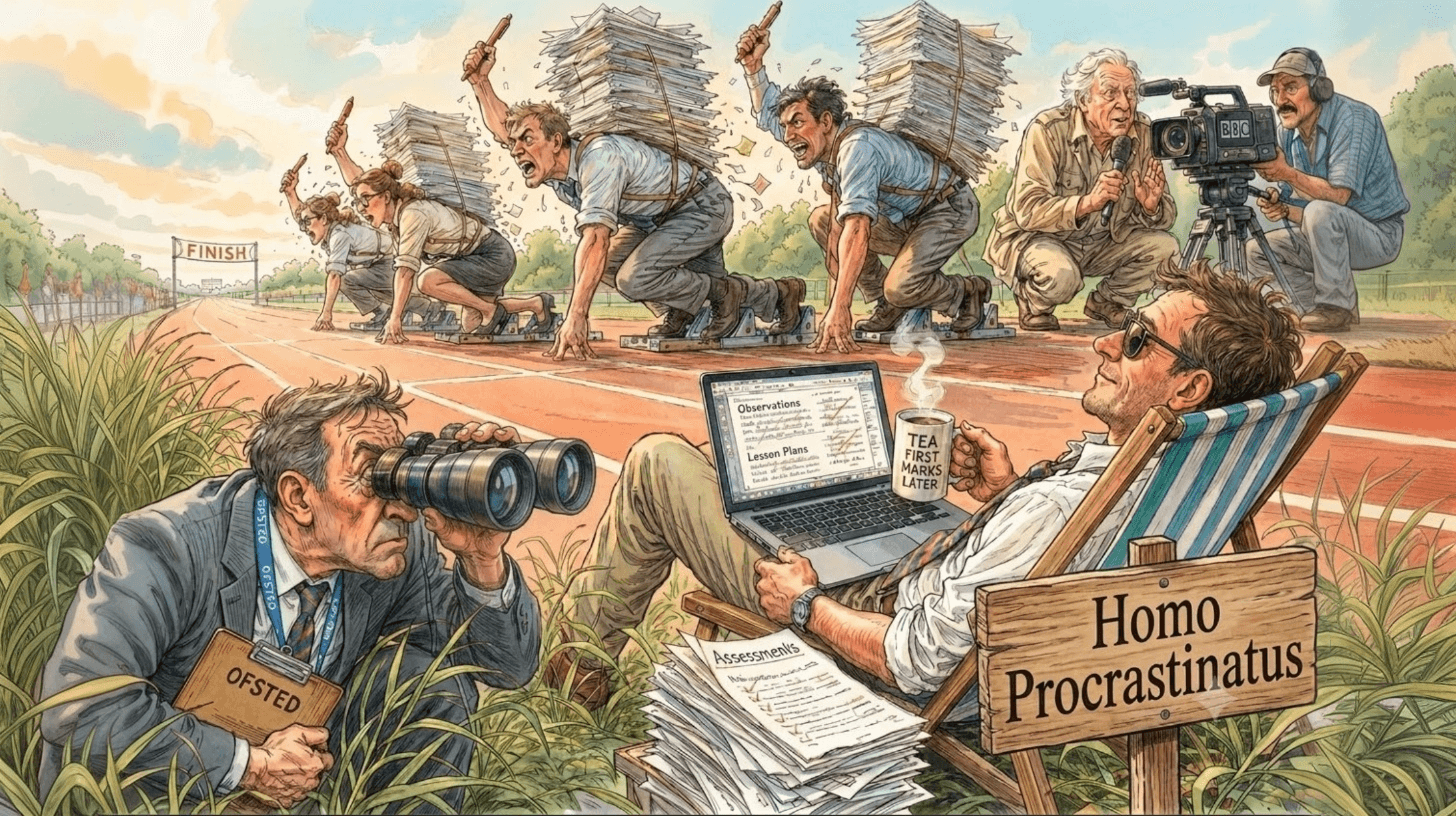
The lazy teacher wins the race
We observe the specimen in its natural habitat. Homo procrastinatus. A lone secondary school teacher.
This teacher is, above all else, a creature of extraordinary vigilance. Do not be fooled by the stillness. The thousand-yard stare is silent computation. Behind the eyes, a threat scan runs continuously.
First: the cover list is checked. The school-wide email that lands at 7:30am, opened with the dread of a jury summons, checked at every red traffic light on the commute in. The teacher scrolls. Their name is not on it. A minor victory. The cover list changes at 8:29. Registration cover is called. The dream of a second coffee dies.
They arrive at school several minutes early. Ok, several seconds. The corridor incident from yesterday requires a plan. A gang of giggling Year 8s materialised outside the classroom door at 1:22pm. Technically lunch. The students wore the expression of someone preparing to say "can we talk to you about something?" Six words that have never, in recorded history, preceded the enjoyment of a sandwich in peace.
Registration complete. The determined power walk toward the photocopier. A small prayer is made that it is not in use. Other teachers depart in dismay. The machine has jammed. The teacher senses opportunity. While easily putting off ECTs, this printer is no match for an adult male on UPS, who with a flurry of strikes to hidden drawers brings the machine to life and receives the vital worksheets for lesson 1 that should have been printed yesterday.
By lesson 3 the teacher is on coffee number four, marker number three, and in desperate need of a sugary snack. Vertigo is setting in from the constant behaviour management, sensory overload, and the need to assert dominance over the juvenile males who circle, taunt and test boundaries to impress other members of their troop on this painful journey to adulthood. He is reminded of his own adolescence. This does not increase his patience. He has held his nerve.
By lunch, approximately seventy-two attempts have been made to get shirts tucked in, four iPhones confiscated and three detentions set. He briefly considers whether a stapler may be a permanent solution to the shirt issue. There may be safeguarding concerns. He dismisses the idea. He sits at his desk through lunch thinking about his life choices, then jumping out of his chair, remembers he has left his second round of printing at the other end of the school.
2:20pm on a Friday, lesson 5. Staring down the barrel of a Year 10 class with the scent of the summer holidays ahead. The distant sound of very sensible shoes on a hard corridor floor echoes. An SLT drop-in. Unannounced. Hence "drop-in." A smile that was technically present. "Thank you for inviting me into your lesson."
The teacher adjusts posture. Makes meaningful eye contact with the front row. Step count doubles. Skilfully remembering and deploying "I do, we do, you do" and "pose, pause, pounce." This appears to have satisfied the observer. This time.
Only now, at 4:48pm, does the pile of assessments come into view at home, which officially can be done in directed hours. Unofficially, the teacher cannot remember what the term 'directed hours' means.
The avoidance rituals begin
First: the tea. Made with great ceremony. Never drunk. Left somewhere between the kettle and the table, cooling gently. It will go cold.
Next: the desk reorganisation. Pens sorted by colour. Sticky notes restacked. A stapler that has not been used in living memory is moved eighteen centimetres to the left. Then back. This process takes eleven minutes and achieves nothing, but it feels like progress, which is close enough. "Perhaps the laundry needs doing. What about the kitchen cabinets." Various avoidance strategies run like a script.
Finally, with the reluctance of someone defusing a bomb, contact is made, red pen in hand.
Marking begins
"What went well: great use of key terminology." "What went well: really good use of key terminology." "What went well: excellent use of key terminology. Well done!"
These are, philosophically, the same sentence. The teacher knows this. The teacher does not care. They have written it seventeen times and will write it fifteen more. By assessment twenty-three, the handwriting has evolved into something that is technically a new language.
The "even better if" section fares no better. "Even better if you had included more detailed analysis." Applied to twenty students, this implies twenty students all made identical errors. They did not. The teacher knows this. The teacher is operating on fumes and the structural memory of what feedback is supposed to look like is evaporating fast.
A brief thought experiment
Elon Musk automates a rocket. Reusable. Lands itself. He gets the cover of Time magazine, three documentaries.
A teacher uses a rubber stamp that says "Marked and understood" instead of handwriting it for the forty-second consecutive time. They get a look from their line manager. The kind of look that says "is that really in line with our marking policy? Has that stamp got a stamp of approval?"
An engineer writes code that does their job automatically while they drink an oat milk latte and think about their next side project. They are called a genius. They give a Ted Talk.
A teacher finds a tool that marks 30 assessments in a PPA, reviews every mark, adjusts where needed, and returns feedback to students faster than any teacher in history. They are, apparently, cutting corners. Won't put in the work like everyone else. "5 to 8 hours of marking in your free time is part of the job, although you shouldn't mark in your free time because of #teacherwellbeing, however it's due on Monday." The teacher has been repeatedly told it is a calling. They are not convinced that is the Oxford dictionary definition.
What is actually happening
Let us be clear about what is actually happening.
The average secondary school teacher works 50+ hours a week. They did not agree to fifty hours. They agreed to a job they believed in. The surplus hours exist because the education system is only financially viable if teachers quietly absorb the excess as a personal contribution. The pile on the kitchen table is not evidence of laziness. It is evidence of a workforce subsidising an underfunded system with their evenings, their weekends, and a significant portion of their mental health.
1 in 3 teachers does not make five years. 9 in 10 cite workload as the reason they leave. 4 in 5 report experiencing mental health symptoms. These are not the statistics of a lazy profession. These are the statistics of a profession that has been running on goodwill so long that the goodwill is running out.
Teachers are not lazy. Schools also do care a great deal. They are just operating in an impossible system. Another 'wellness week', however well intentioned, will not reduce workload.
The actual answer is tools that work. We are Homo sapiens. Our species is defined by the ability to use tools. What were once flint and sticks snowballed into combustion engines and microprocessors. The teacher, however, is still equipped with a red biro, a passion for teaching, and an unholy tolerance for stress.
What a sensible teacher toolkit looks like
Here is what a sensible teacher toolkit looks like right now.
Worksheets and resources. Teachmate.ai generates differentiated classroom resources in seconds. The worksheet that used to take a Sunday afternoon can now be done before registration. It is not cheating. It is what every other profession would call a reasonable use of available technology.
Lesson planning and admin. Planning software such as MagicSchool, Eduaide and Oak National Academy's Aila produce first drafts of lesson plans, quizzes, homework and classroom resources.
Marking. A DfE and GDPR compliant tool like DeepMark takes piles of handwritten assessments and produces marked papers with hundreds of annotations and personalised feedback for every student in minutes. You confirm the marks, press print and go home. The marking is yours, as is your weekend.
This is not laziness
Laziness is avoiding the work entirely and hoping nobody notices. This is doing the work better, faster, and with enough energy left over to actually remember why you went into teaching in the first place, and perhaps who you are outside of it too.
The pile will always exist. The question is whether the teacher will adapt, improvise and not just survive, but thrive against the odds.
The teacher closes the laptop. The pile, for once, is gone by 3:30pm. The tea is drunk while it is still warm, a novel experience.
The race, it turns out, goes not to the one who stayed latest and could hack it. But to the one who found better systems and tools.
Toss the red pen in the bin. We dare you.
See it live
This is DeepMark marking a real script
Scroll through as it marks. Feedback and annotations appear as they land. Click anything, highlight, edit a mark to get a feel for how it works.