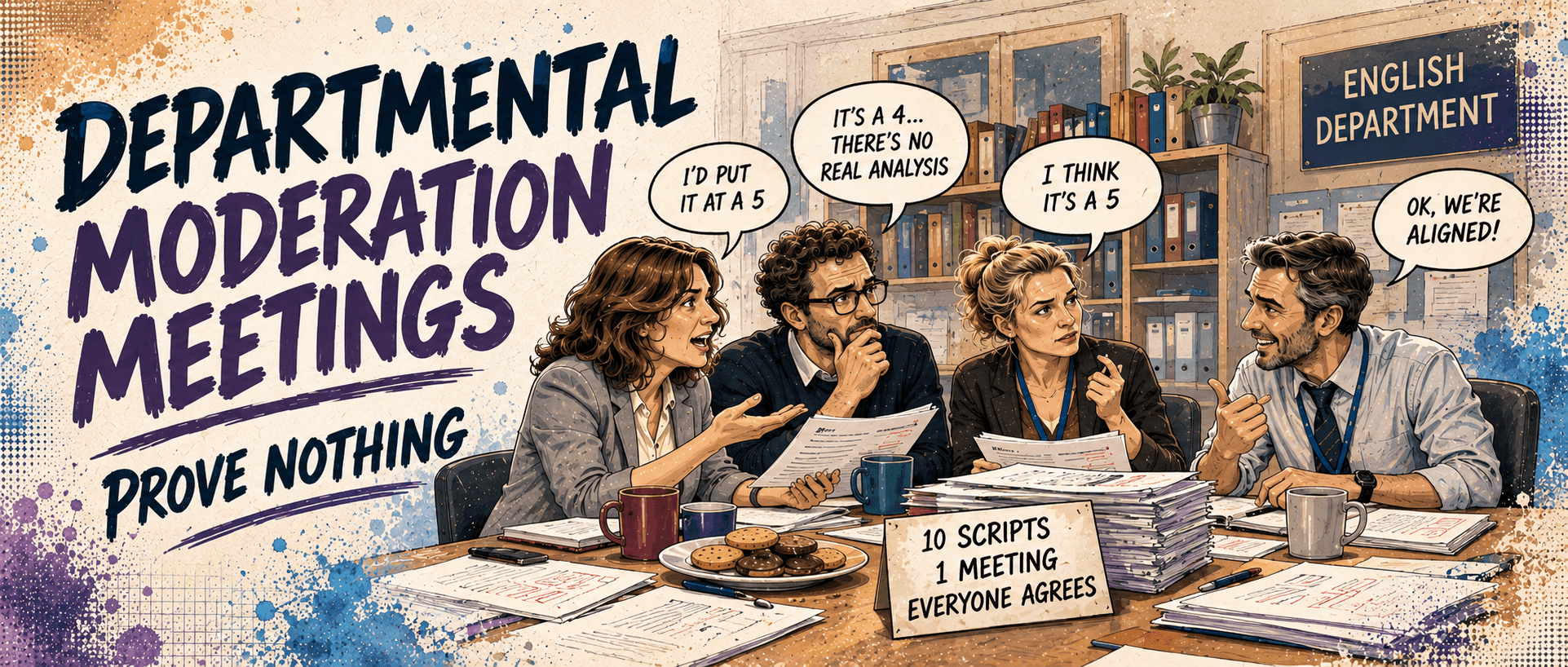
Your department's moderation meeting proves nothing
The meeting proves that four teachers can agree in a room. The grades do not come from the room.
It's October. Somewhere in your school, 4 English teachers are round a table with 10 scripts and a plate of biscuits. They mark a script each, compare, argue briefly about whether "Shakespeare uses language to show" counts as analysis, and settle on a mark. By half four everyone is aligned.
Then they go away and mark 150 scripts each. Alone. A few squeezed into a PPA period, a few more after a full day of teaching, and the rest quietly at home on a Sunday, when they'd rather be at the park with their kids.
That second part is where the grades come from.
The meeting does tell you something useful: that a group of teachers can agree when they're in the same room, looking at the same answer, with the head of department's eyebrows in view. What it can't tell you is anything about script 117 at 10pm, when the marker is tired and the mark scheme is in another tab and the answer in front of them is either brilliant or illegible.
Some departments sample afterwards. A handful of scripts, pulled the week before reports go home. Better than nothing, but most of the marks still rest on one conversation, held once, over coffee.
Exam boards don't trust it either
Exam board examiners get standardised as well. Then, while they mark, scripts with agreed marks are slipped into their allocation without warning, and anyone who drifts too far gets stopped.
Even with all that machinery, Ofqual's 2018 data found two trained examiners marking the same 6 mark answer agreed between 46% and 75% of the time.
Your department has biscuits.
Where this stops being funny
Mock grades get sold to students as low stakes. For the adults, they're anything but. They decide who gets an intervention place in January, feed predicted grades, move students between sets and tiers, and sit behind the phone call from a parent asking why her daughter is "a 4 in English when she got a 6 in the summer."
The students who lose most from inconsistent marking tend to be the quiet ones on the 3/4 line, whose intervention place depends on a mark nobody checked after the meeting finished.
If that parent pushes, what's on the table? A mark on a cover sheet and a head of department who's fairly sure. Nobody can show who marked which question, what standard was agreed, or whether script 117 got the same treatment as script 3. The directed time went in and nothing came out that a governor could look at.
That's a governance gap sitting inside your assessment data, and it belongs to SLT whether anyone has named it or not.
What you can change before Year 11 mocks
In most schools Year 11 mocks land somewhere between late November and Christmas. That leaves a few weeks, and none of what follows needs a budget line.
Split the marking by question instead of by class. If one teacher marks question 5 for the entire cohort, every student gets the same marker on that question, and consistency comes from the rota before anyone's judgement gets a say. It's quicker as well, because you hold 1 mark scheme in your head instead of 6.
Seed the pile. Take the scripts agreed in the meeting, strip the names, and slip 2 into every marker's pile. See what comes back.
And write the calls down. 5 lines a question is plenty.
The question worth asking
A department that can show its marking held up after the meeting has something most schools don't: evidence. The SLT that asks for it this term will have an answer when a governor or a parent asks the hard question. Everyone else will have a feeling, and a plate of biscuits.
I teach GCSE Citizenship and Business Studies, and I cofounded DeepMark, a marking platform built around this exact problem that also speeds the whole thing up. So weigh the above accordingly.
Sources
- Ofqual, Marking consistency metrics: an update, November 2018 (Ofqual/18/6449/2).
See it live
This is DeepMark marking a real script
Scroll through as it marks. Feedback and annotations appear as they land. Click anything, highlight, edit a mark to get a feel for how it works.